The John Rush Method For Building Directories
The Weekend Directory Blueprint: How to Build a Cash-Flowing Asset in 48 Hours (The John Rush Method)
In the world of online business, there is a prevailing myth that you need to build the next Salesforce, Uber, or Airbnb to be successful. We are told to spend months writing code, seeking Venture Capital, and burning the midnight oil on complex SaaS (Software as a Service) products.
But the reality of the startup world is harsh: most traditional SaaS companies fail. They require massive teams, long development cycles, and deep pockets.
There is a better way for the solo builder.
Based on insights from "Super Builder" John Rush (who was recently interviewed by Greg Isenberg), there is a strategy that allows you to build a cash-flowing asset in a single weekend. The business model? Directory Websites.
John Rush suggests that an average, well-executed directory project can generate $3,000 to $5,000 per month. With the right scaling, that can hit $20,000. Best of all, you can build the MVP (Minimum Viable Product) in one evening using no-code tools.
This article breaks down the exact methodology—from ideation to exit—on how to launch a profitable directory project without writing a single line of code.
The Golden Era of Curation: Why Directories Are Back
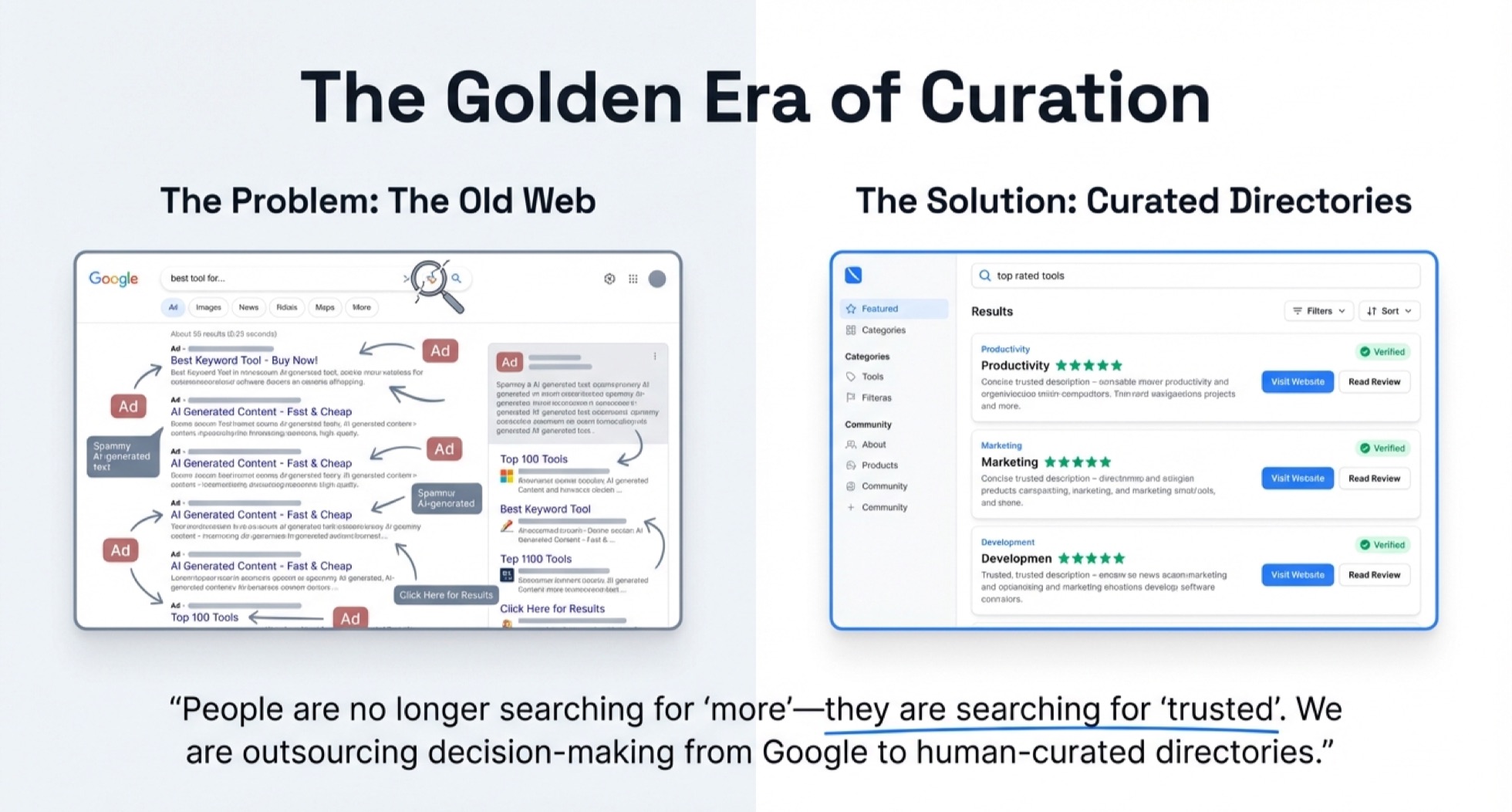
You might think directories are a relic of the 90s internet—like the old Yellow Pages or early Yahoo. You would be wrong. We are currently entering the Golden Era of Curation, and Artificial Intelligence is the catalyst.
The "Old Web" was cluttered with ads. Today, the "New Web" is facing a different problem: AI-generated noise.
If you go to a search engine or ChatGPT and ask for "the best marketing tools," you will get a generic, hallucinated, or SEO-spam list. People are drowning in low-quality content. They don't trust the ads, and they are skeptical of generic AI answers.
Users are craving Human Curation.
Consider the real estate market. You can look at data on Zillow all day, but that data won't tell you the "vibe" of the neighborhood. For that, you need a local—a human expert. A directory acts as that local expert for a digital niche. By filtering the noise and presenting only the best options, you provide immense value.
The Business Case: Low Risk, High Reward
John Rush frames the directory model as an alternative to high-risk startups.
Traditional SaaS: Months of coding, high burn rate, requires a team, extremely high failure rate.
Directory Project: Built in 1-2 days, no code required, runs on low cost, leverages SEO for free traffic.
If you build a SaaS and it fails, you lose six months of your life. If you build a directory and it fails, you lose a weekend. This allows you to adopt a "Portfolio Strategy"—launching 5 or 10 ideas, seeing which one gains traction, and doubling down on the winner.
Step 1: Ruthless Ideation and Validation
Before you touch a website builder, you must validate that people actually care about your topic. Do not guess. Use data.
The Keyword Volume Check
Go to the Google Keyword Planner. You are looking for a "Goldilocks" zone:
Sufficient Search Volume: Are people actually looking for this?
Low Competition: Is the market already saturated by massive competitors?
You need existing traffic. A directory captures existing demand; it rarely creates new demand.
The Domain Hack and Semantic Indexing
John Rush’s example project is called "Mini Business Ideas." He wanted to rank for "Small Business Ideas," but those domains were taken.
He relied on Latent Semantic Indexing (LSI).
Google is smart enough to know that "Mini" and "Small" are synonyms in this context. It understands that "Boots" means one thing in the context of "Skiing" and another in the context of "Soccer." You don't need the exact match .com anymore. You need a domain that signals the intent of the site.
Don't let the lack of a perfect .com stop you. Get a domain that is close enough, and let your content do the heavy lifting.
Step 2: The "One Evening" No-Code Build
This is where most aspiring entrepreneurs get stuck. They over-engineer the solution.
The Rule: If it takes you more than a weekend to build the first version, you are taking too long.
John Rush advises against using complex frameworks like NextJS, PHP, or custom coding for the initial build—even if you are a developer. It is a waste of time for the validation phase.
The AI Build Stack
To achieve the "one evening" build, you need to leverage modern tools. The recommended stack revolves around Unicorn Platform.
Unicorn Platform (which John Rush actually acquired) is designed specifically for startups and directories. It allows you to:
Build beautiful, responsive interfaces using drag-and-drop blocks.
Integrate directly with Google Sheets or Airtable to manage your directory data.
Use built-in AI to generate copy and layout.
The goal is not to have a site with custom animations and perfect pixel placement. The goal is to have a functional database of curated information that looks professional. Unicorn Platform handles the "looking professional" part so you can focus on the data.
Step 3: Programmatic SEO and The "FAQ Loop"
How do you get traffic without paying for ads? You need Programmatic SEO (pSEO).
Programmatic SEO involves creating hundreds or thousands of landing pages based on data, rather than writing each one by hand. If you have a directory of "AI Tools," you can programmatically create pages for "AI Tools for Lawyers," "AI Tools for Doctors," "AI Tools for Writers," etc.
The FAQ Loop
To capture long-tail traffic, you must answer the specific questions users are typing into Google.
Use AnswerThePublic.com: Type in your niche keyword. It will give you a visualization of every question asked about that topic.
Scrape "People Also Ask": Look at Google's search results and see what related questions pop up.
Structure your directory content to answer these questions directly. If you can answer the specific, niche questions that the big competitors ignore, you will capture the high-intent traffic.
Note: Be careful not to scale too fast. If you publish 5,000 pages on Day 1, Google might flag you as spam. Scale up your content velocity gradually.
Step 4: The 30-Day Hustle (Distribution)
Once the site is live, the clock starts. John Rush recommends a "30-Day Sprint." If the project doesn't show signs of life after 30 days of hard marketing, kill it and move to the next idea.
Manual Signal Generation
You cannot rely solely on SEO in the first month because of the Google Sandbox—a period where Google analyzes your new site to see if it is trustworthy. During this time, you need to manufacture your own traffic.
Reddit Strategy: Reddit is the best place to launch because you don't need an existing audience. You can be anonymous. However, you cannot just spam your link. You must provide value. Create a post detailing your findings or curation process, and drop the link in the comments or bio.
Social Listening: Set up alerts for your niche keywords on X (Twitter) and Reddit. When someone asks a question your directory solves, jump in and answer it.
Directory Inception: List your directory on other directories. This sounds meta, but there are directories of startups (like BetaList, Product Hunt, etc.). Getting listed there provides high-quality backlinks, which signals to Google that your site is legitimate.
Step 5: Expert Mode
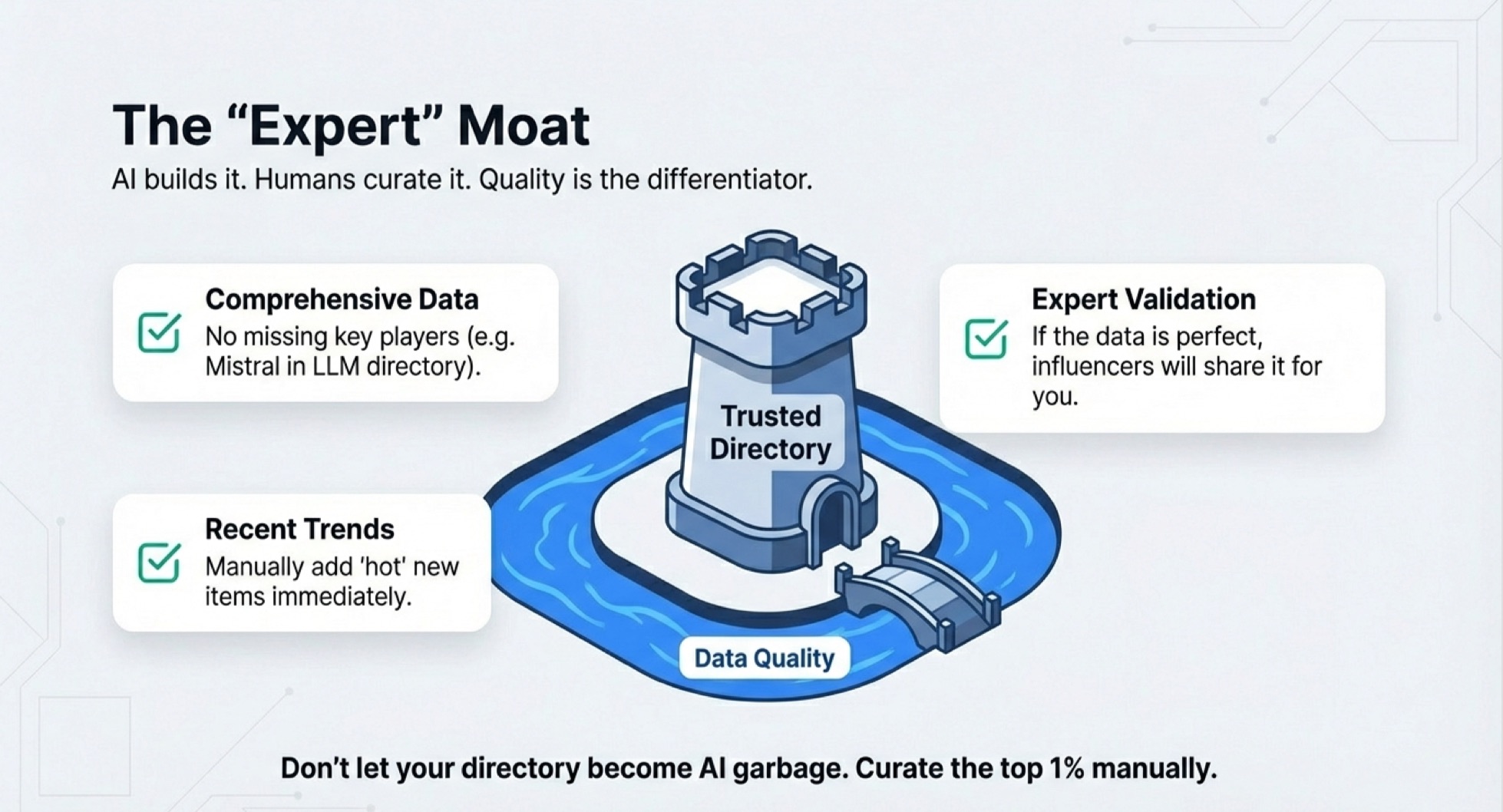
AI can build the website, and AI can write the summaries, but AI cannot provide the Expert Validation.
To win long-term, you must be comprehensive. You cannot have "missing key players." If you have an LLM directory and you don't list Mistral (the French AI model), your directory loses credibility.
Expert Mode Checklist:
Comprehensive Data: Ensure you have the obscure options, not just the famous ones.
Recent Trends: Use Google Alerts to spot new tools/businesses and add them immediately. Being the first to list a new tool can bring massive traffic.
Human Insight: Add a "Review" or "Verdict" section that is clearly written by a human.
When your data is perfect, influencers in that niche will share your directory for you because it makes them look smart.
Monetization: How to Generate $5k/Month
Traffic is vanity; revenue is sanity. Here is how you turn a directory into a paycheck.
1. Affiliate Marketing (The Easiest Path)
This is the low-hanging fruit. If your directory lists software, courses, or high-ticket items, use affiliate links. If you rank high for "Best Email Marketing Software" and a user clicks your link to sign up for a tool, you get a recurring commission.
2. Sponsorships and Featured Listings
Once you have traffic, companies will pay to be at the top of the list. You can charge a monthly fee for a "Featured" spot or a "Verified" badge. This is pure profit.
3. Pay-to-View (Gatekeeping)
For highly valuable, hard-to-find data, you can lock the details behind a paywall. John Rush used this for his business ideas directory, charging a one-time fee (e.g., $39) to access the full database of verified ideas.
4. The Lead Gen Flywheel (Underrated)
This is a strategy for those who already have a main business. Use the directory to attract cheap SEO traffic, then place a notification bar at the top or bottom of the site offering a freebie (a PDF, a course, a consultation).
This funnels directory traffic into your email list, allowing you to sell them your own high-ticket products or SaaS subscriptions.
The Exit: Selling the Asset
A directory is a digital real estate asset.
If your directory generates $2,000/month in profit, it doesn't just put cash in your pocket; it builds equity. Online businesses typically sell for a multiple of their monthly revenue (often 20x to 40x).
A directory making $3,000/month could potentially be sold on marketplaces like Flippa or Acquire.com for $60,000 to $100,000.
You can also perform "Private Outreach." If you build a directory of "Podcasting Tools," you could reach out to a major Podcast Hosting company and offer to sell them the directory. They need the traffic, and buying your site is cheaper for them than building their own SEO strategy from scratch.
Conclusion: Massive Action Required
The blueprint is simple, but it is not easy. It requires a frantic, focused burst of energy.
Ideate using keyword volume.
Build in one evening using Unicorn Platform.
Hustle for 30 days on Reddit and Socials.
Scale if it works, Kill if it doesn't.
You are one weekend away from having a potential $5k/month revenue stream. Stop overthinking the code stack. Stop worrying about the perfect logo. Block off your Saturday and Sunday, drink a lot of coffee, and build.
There is no substitute for massive action.
Resources Mentioned
Unicorn Platform: The AI-powered website builder recommended for directories.
Google Keyword Planner: For validating search volume.
Answer The Public: For generating FAQ content ideas.
Flippa / Acquire.com: Marketplaces to sell your finished directory.
Software tools related to The John Rush Method For Building Directories

John Rush Directory Guide
John Rush Directory Guide: How I build directory websites for profit - By John Rush of MarsX

Unicorn Platform AI Website Builder for Busy Founders
Unicorn Platform is an AI website builder that helps to quickly create websites without design or development skills for SaaS, Apps, Directories, Blogs, Personal pages, and more.

Directify: No-Code Directory Builder
Directify is a super-easy to use no-code directory builder. You can have multiple directory sites for a one-time payment. Click to read Directify reviews
EmbedDirectory - Customizable Directory for Your Website
Create engaging directory experiences with powerful search, custom layouts, maps and filters. Easy to embed on any website platform.

Lead Scrape | Local Leads Scraper Software
Find new business leads. Lead Scrape helps you find B2B companies in any industry and supports over 50 countries. Free Trial Available for Windows & Mac OS.

Spread Simple: Turn Google Sheets Into a Directory Website
Build a Directory on SpreadSimple; the easiest platform that transforms Google Sheets into searchable, filterable directory websites. Discover why it's perfect for location-based listings and business directories.