Baserow | MIT-Licensed No-Code Database You Can Actually Fork
About
An open-source Airtable alternative with an MIT-licensed core. The hosted free plan gives 3,000 rows per workspace, and self-hosting removes the row limit entirely.
Most open-source database tools use a copyleft licence. NocoDB is AGPLv3. That is a real licence with real obligations, and if you ever intend to build a product on top of the code, you need to read it carefully.
Baserow's core is MIT.
MIT is about as permissive as software licensing gets. Use it, modify it, ship it inside something commercial, keep your changes private. The obligation is essentially "keep the copyright notice."
For most directory builders that difference is academic. For anyone planning to build a directory product rather than a directory site, it is the whole decision.
What Baserow is
A no-code database with a spreadsheet interface, the same category as Airtable and NocoDB.
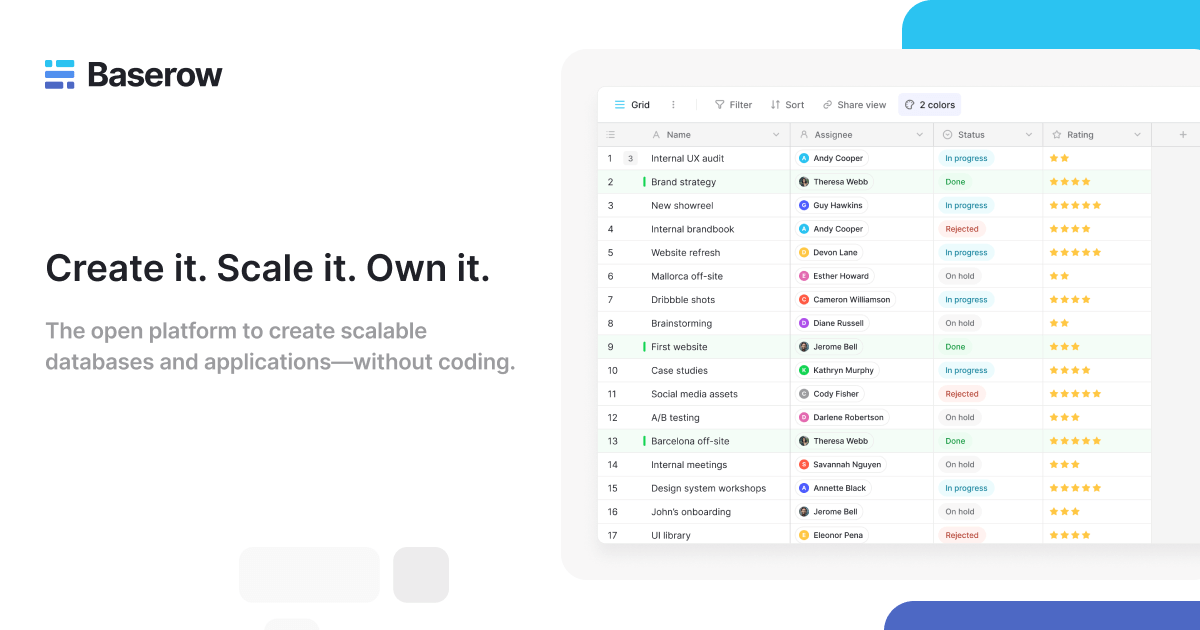
You create tables, define fields, link records between tables, and build views over the data. There is a REST API over everything, so your front end reads listings directly rather than through an export.
The interface is clean and noticeably fast. Baserow was built after Airtable existed and is unapologetic about being the open alternative to it.
It is developed in the open on GitLab rather than GitHub, which is a small detail that tells you something about the project's disposition.
Row limits are the number that decides
For a directory, every one of these tools comes down to the same question: how many rows before it costs money.
Baserow's hosted plans are explicit about it, which is more than most manage.
| Plan | Price | Rows per workspace | Storage |
|---|---|---|---|
| Free | $0 | 3,000 | 2 GB |
| Premium | $10/user/month yearly, $12 monthly | 50,000 | 20 GB |
| Advanced | $18/user/month yearly, $22 monthly | 250,000 | 100 GB |
| Enterprise | Custom | 1,000,000 | Custom |
Now map that onto real directories.
A curated niche list of 500 tools fits the free plan with room to spare. A single-city local directory of 2,500 businesses just about fits. A multi-city directory does not, and you are on Premium at $10 a month.
At 250,000 rows you are into Advanced at $18 a month, which is still cheap for a database holding a quarter of a million listings.
Self-hosted, the row limit is whatever your server can handle.
The self-hosted question
Baserow self-hosts on Docker. The core is MIT and free with no row ceiling. Premium and Enterprise features sit behind a separate commercial licence, so self-hosting gives you the database without the advanced governance layer.
That split is the same shape as NocoDB's, and for a solo directory builder the answer is the same: the features behind the paywall are permissions, auditing and single sign-on, none of which matter when the team is one person.
The genuine difference between the two is the licence on the core. AGPLv3 versus MIT. If you are just running a directory, ignore it. If you might one day sell a directory platform built on this code, read both licences before you pick.
Where it fits in a directory stack
Source of truth for listings. Scrape in, clean in the grid, expose through the API. Your directory front end never talks to a scraper directly, it talks to Baserow.
Submission intake. Form views write straight into a table. Add a Status field, filter a view to Pending, approve by changing a cell.
Editorial workflow. This is the part people underrate. A directory needs someone to look at rows and decide things, and a grid with filters is a far better surface for that than any CMS admin screen.
Where it does not fit
It is a database, not a directory. Baserow holds and organizes your listings. Rendering them as pages that Google can index is a separate job for a separate tool.
Self-hosting is a real commitment. Docker, a server, backups, upgrades. Cheap in money, not free in attention.
The ecosystem is smaller than Airtable's. Fewer prebuilt integrations, fewer templates, fewer people who have already solved your exact problem and posted about it. You will occasionally be the first person to try something.
And the free hosted tier at 3,000 rows is tighter than NocoDB's self-hosted unlimited. If your plan is "free forever," compare those two directly rather than comparing hosted to hosted.
Common questions
MIT or AGPL, does it actually matter to me?
Only if you distribute software built on it. Running a website that reads from Baserow is not distribution under either licence. The distinction bites when you package the code into something you ship to other people.
How does it compare to NocoDB?
Very close on features. Baserow's interface is somewhat more polished, NocoDB's free self-hosted tier is more generous, and the licences differ. Try both for an hour and pick the grid you prefer working in, because that is where you will spend your time.
Can it handle a hundred thousand listings?
Self-hosted on adequate hardware, yes. Hosted, that is the Advanced plan. Either way, put an actual search engine in front of it before you ask users to search that many rows, because a database filter is not a search experience.
Does it have an API?
Yes, REST, auto-generated per table, with good documentation. That is the connection point for your front end and for anything you automate.
Where is the code?
GitLab, developed openly. The project has been going for years and ships regularly, which is worth checking on any open-source dependency before you build on it.
Verdict
Baserow and NocoDB solve the same problem well, and for most directory builders the choice between them comes down to which interface you prefer.
Pick Baserow when the licence matters, when you want the clearer published row limits on hosted plans, or when the interface simply suits you better.
Start on the free hosted tier. 3,000 rows is enough to build the whole structure and prove your front end reads it correctly. Move to self-hosted when the row count starts costing money, not before.
Location & Contact
Contact
Baserow | MIT-Licensed No-Code Database You Can Actually Fork