SerpApi | Google Maps and Search Results as Structured JSON
About
An API that returns Google Maps places and search results as clean JSON, with place_id, coordinates, hours, ratings and phone numbers. Paid plans include a legal shield. Free tier gives 250 searches a month.
Every other page in this category eventually reaches the same paragraph. Is scraping legal? Probably, if the data is public, but read the terms of service, and here is a disclaimer because nobody writing about this is your lawyer.
SerpApi answers that differently. Its paid plans include a legal shield, where SerpApi takes on legal responsibility for the scraping being done on your behalf.
Whether that matters to you depends on how much of your business is going to sit on top of scraped data. If the answer is "all of it," it is worth understanding what you are actually buying here.
What SerpApi is
It is an API, not an app. You send a request, you get JSON back.
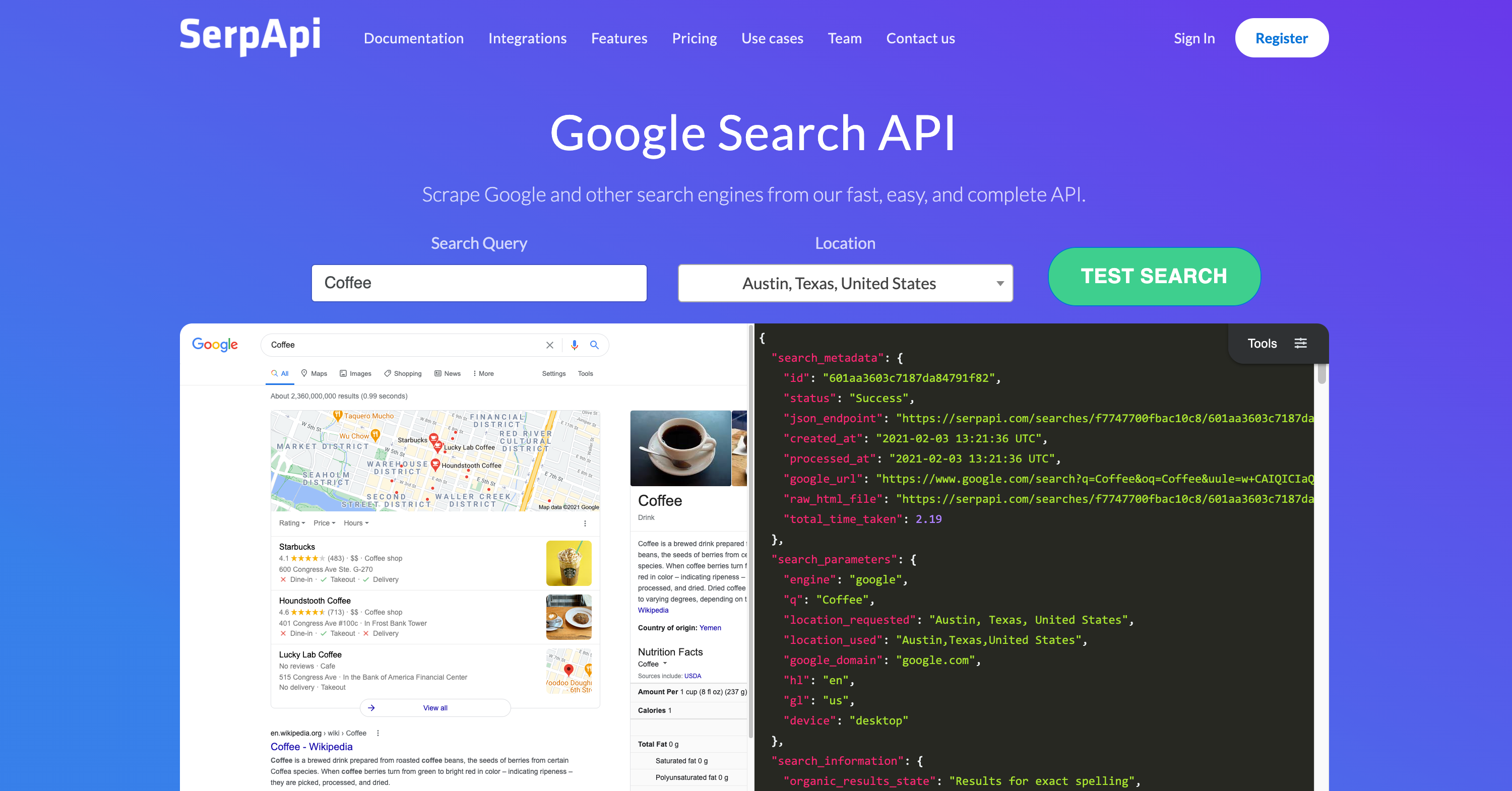
There is no interface to learn, no robot to train, no desktop software. You call an endpoint with a query and parameters, and structured data comes back immediately. That makes it the natural choice if your directory is built on code, or if you are wiring a pipeline through n8n, Make or a scheduled script.
If you want to click on things, this is the wrong tool and Octoparse is the right one. If you want a data source your directory can call on a schedule without you touching it, this is the shape that fits.
The Google Maps endpoint, field by field
This is the part that matters for a local directory, and it is worth being specific because "it scrapes Maps" undersells it.
A single Maps request returns, per place:
Identity and location. place_id, data_id, data_cid, GPS latitude and longitude, full address, country.
Business detail. Title, phone number, category and type, daily opening hours broken out by day, service options like dine-in and curbside pickup.
Signals. Rating, review count, price range.
Media and follow-on links. Thumbnail images, plus a photos_link and a reviews_link that point at further endpoints.
That reviews_link is the useful detail. Reviews come from a separate google_maps_reviews engine rather than being crammed into the place response, which keeps your initial calls cheap. You pull the place data for 5,000 businesses, then fetch reviews only for the few hundred that matter.
The place_id is the other thing to notice. It is Google's own stable identifier for a business, which gives you a reliable key to deduplicate against and to re-query later when you want to refresh a listing. Deduplication is the unglamorous problem that ruins scraped directories, and having a canonical ID solves most of it.
The second job: your own rankings
Here is where SerpApi does something the other scrapers in this category do not.
The same account that fills your directory also tells you how your directory is doing. SerpApi returns standard Google search results, so you can track where your listing pages rank for their target queries, watch which competitors hold the positions above you, and see which of your pages have picked up featured snippets.
For a directory, that is not a nice extra. Directory sites live and die on long-tail organic traffic across thousands of near-identical pages, and rank tracking at that scale gets expensive fast with conventional SEO tools. Running it through an API you already pay for changes the economics.
One tool covering both the data acquisition and the SEO feedback loop is a real consolidation.
Pricing
| Plan | Monthly | Searches |
|---|---|---|
| Free | $0 | 250 |
| Starter | $25 | 1,000 |
| Developer | $75 | 5,000 |
| Production | $150 | 15,000 |
| Big Data | $275 | 30,000 |
| Searcher | $725 | 100,000 |
| Volume | $1,475 | 250,000 |
| Infrastructure | $2,750 | 500,000 |
Higher cloud tiers run from $3,750 up to six figures, which is not this audience.
The free tier is 250 searches a month, throttled to 50 requests an hour. It excludes the legal shield, the privacy features and priority support. It is an evaluation allowance, not a working plan.
Be careful reading "searches" as "results." One search returns a page of places, not one place. The effective cost per row is much better than the headline suggests, but the exact ratio depends on your query, so run a handful on the free tier and measure before you pick a plan.
Where it beats the alternatives
Against Apify: cleaner and more predictable. Apify's Actors are community-built and vary in quality. SerpApi maintains its own parsers as a first-party product, and the response shape is documented and stable. If you are writing code against it, stability is worth more than breadth.
Against Octoparse and Browse AI: no browser, no fragility. Those tools drive a real browser through a real page, which breaks when the page changes. SerpApi handles that layer itself and hands you a contract that does not change under you.
Against everything: the legal shield. Nothing else in this category offers to stand behind the scraping.
Where it does not fit
It is developer-facing. There is no point pretending otherwise. If you are not comfortable making an HTTP request, or wiring one through an automation tool, you will not enjoy this.
It is search-engine focused. SerpApi scrapes search engines and Maps very well. It does not scrape a regional trade association's member list, because that is not a search engine. For arbitrary websites you still need Browse AI or Octoparse.
And 250 free searches is genuinely tight. Enough to confirm the response shape, not enough to seed anything.
Common questions
What counts as one search?
One API request against one engine. A Maps query returning a page of results is a single search, and paginating deeper costs additional searches.
Does the legal shield mean scraping is now definitely fine?
It means SerpApi assumes responsibility for their own scraping activity on paid plans. It is a meaningful protection and a genuine differentiator. It is not a licence to republish copyrighted content. Scrape the facts, write your own descriptions, and that advice does not change here.
Can I use this with no-code tools?
Yes. It is a standard HTTP API, so Make, n8n, Zapier and Airtable automations all call it happily. That is the usual route for people who do not want to write code but do want scheduled data.
Is it better than Outscraper for Maps?
Outscraper is more focused on Maps and easier if that is all you need. SerpApi is better if you also want SERP data, want a stable documented API, or care about the legal shield.
How do I avoid burning searches?
Cache aggressively. Store the place_id for everything you pull, and use it to refresh selectively rather than re-querying the whole set. Directories change slowly. Re-scraping everything monthly is usually waste.
Verdict
SerpApi is the pick when your directory is a real business rather than an experiment.
The reasoning is about risk and consolidation rather than features. You get Google's own place_id as a deduplication key, an API contract that does not break when a page redesigns, rank tracking for the site you are building, and a company willing to stand behind the legality of the scraping. That is a different proposition from renting a scraper.
Start on the free 250 to confirm the fields you need are in the response. Then price the Starter or Developer tier against how many places your niche actually contains, which you should already know from a free tool before you get here.
Location & Contact
Contact
SerpApi | Google Maps and Search Results as Structured JSON