
How to Validate a Directory Niche With Search Data
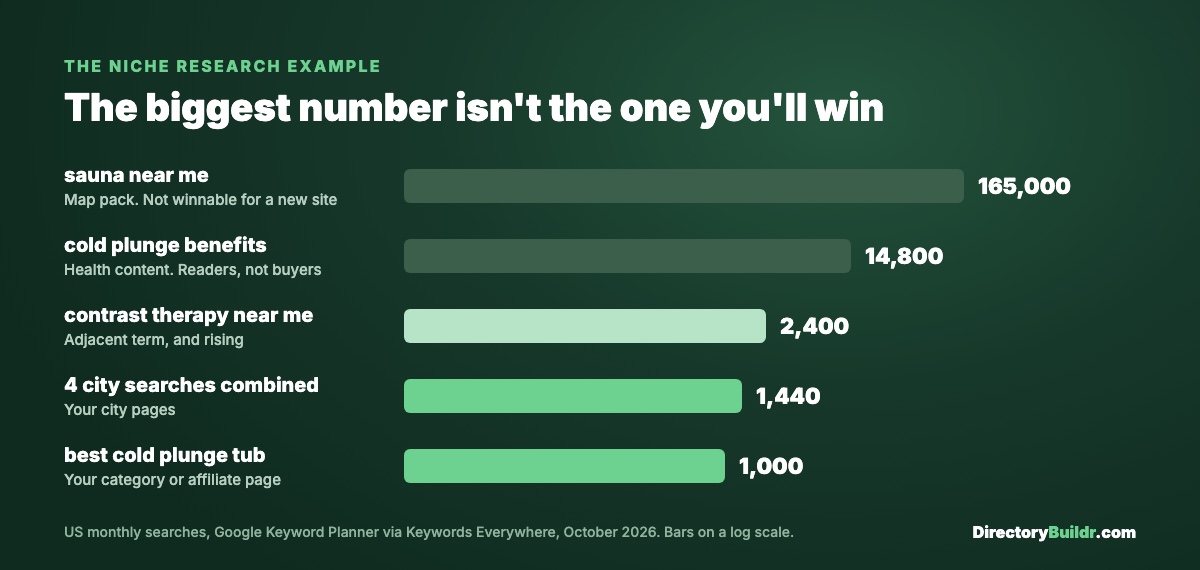
On October 23, 2026, I pulled search volumes for one directory idea: cold plunge and sauna studios. The biggest keyword in the set, "sauna near me", gets about 165,000 US searches a month.
A new directory will never rank for it.
The keywords that actually decide whether this niche works are much smaller. "Cold plunge austin" gets 320. "Best cold plunge tub" gets 1,000. Those are the ones worth looking at, and this guide shows you how to find them for your own idea.
If you're still at the idea stage, start with finding a hyper-niche or, for local businesses, choosing a profitable local niche. This guide picks up once you have one or two ideas and want to know if the search demand is real.
Why big numbers mislead you
Keyword tools sort by volume, so the first thing you see is the biggest number. For a directory, that's usually the wrong number to look at.
"Near me" searches are the clearest example. When someone types "sauna near me", Google answers with its own map. Then come Yelp, Tripadvisor and the studios' own sites. A three-month-old directory isn't getting into that list.
So treat the head term as proof that people care about the topic. Don't treat it as traffic you'll get.
The traffic a directory actually gets comes from the pages it generates: one page per listing, one per category, one per city. So the real question is whether people search in the shape of those pages.
The four kinds of search a directory can win
When I check a niche, I sort its keywords into four groups. Each group maps to a page type you'd actually build.
1. Category plus location. These are your city pages. Here's what the cold plunge numbers looked like (US monthly searches, Google Keyword Planner data pulled through Keywords Everywhere):
| Keyword | Monthly searches |
|---|---|
| cold plunge nyc | 590 |
| cold plunge austin | 320 |
| cold plunge denver | 320 |
| cold plunge los angeles | 210 |
No single row is big. That's normal. Those four cities add up to 1,440 searches a month, and a directory would have a page for every city with a studio. The whole point of a directory is that the long tail adds up.
2. Buying and comparison searches. These are your affiliate pages, and they're where product directories make money.
| Keyword | Monthly searches |
|---|---|
| cold plunge tub | 27,100 |
| cold plunge chiller | 3,600 |
| best cold plunge tub | 1,000 |
| cold plunge tub for sale | 480 |
| cheap cold plunge | 320 |
"Best cold plunge tub" is exactly the shape of a directory category page: a filtered, compared list of products.
3. Adjacent searches that widen the niche. This is the group most people skip, and it often changes the idea.
| Keyword | Monthly searches |
|---|---|
| bathhouse near me | 33,100 |
| contrast therapy near me | 2,400 |
| sauna and cold plunge near me | 2,400 |
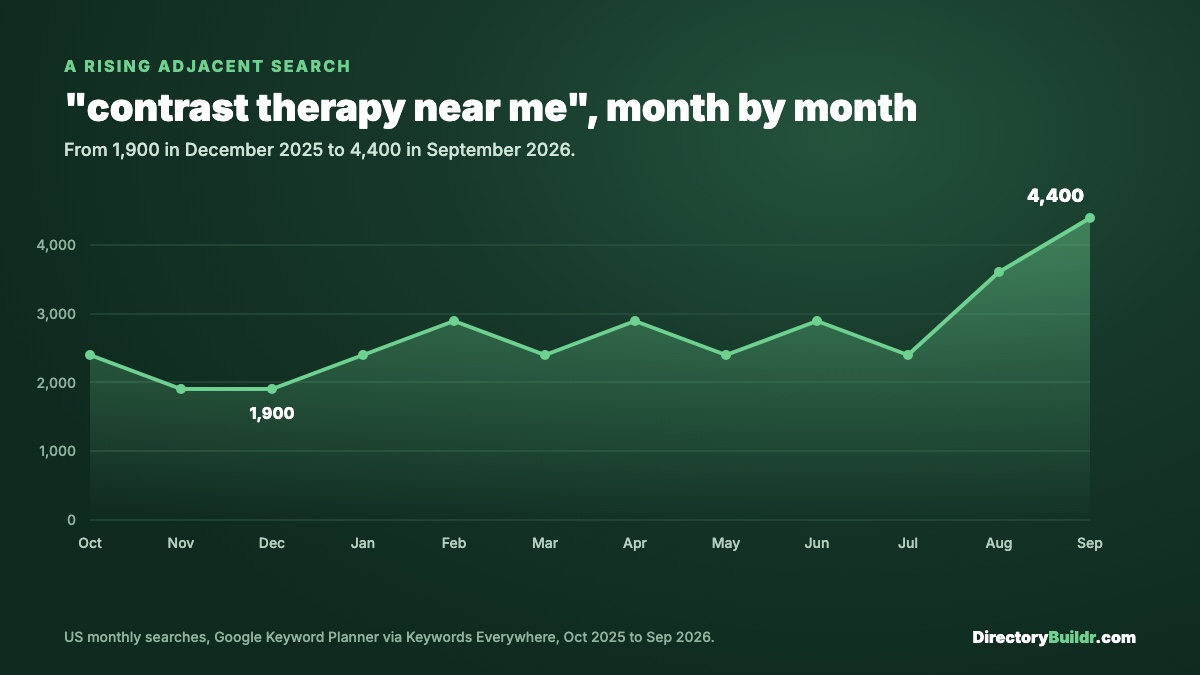
"Contrast therapy near me" is the interesting one. It averages 2,400, but the monthly figure went from 1,900 in December 2025 to 4,400 in September 2026. A rising term like that tells you how the market describes itself now. It suggests the directory should be "sauna and cold plunge" or "contrast therapy," not cold plunge alone.
4. Informational searches. "Cold plunge benefits" gets 14,800. That's real interest, but it's health content, Google is strict about who it trusts on health, and the searcher doesn't want a list of studios. Write a few of these to support the site. Don't build the business on them.
Read the money columns properly
Keyword tools show two more columns, and both are easy to misread.
Competition is not ranking difficulty. In Keyword Planner data, competition measures how many advertisers bid on the keyword. "Cold plunge tub" scores 1.0, the maximum. That doesn't mean it's impossible to rank. It means companies are paying to reach these searchers, which is exactly the signal you want.
CPC is what an advertiser pays per click. It's a rough stand-in for what a visitor is worth. The cold plunge city terms sit between $0.78 and $1.75. For comparison, "coworking space near me" is $5.48. A higher CPC usually means businesses in that niche will pay more for a featured listing too.
Check who's ranking before you commit
Volume tells you people search. It doesn't tell you whether you can rank. For that, search five or six of your best keywords and look at page one.
Hard to crack: the Google Maps pack, then Yelp, Tripadvisor and big brand sites all the way down.
An opening: Reddit threads, forum posts, a local news "best of" article from 2022, a thin directory with 30 listings and no details. Those mean Google doesn't have a good answer yet. A directory with real details on every listing can be that answer.
Look for that pattern on the city searches especially. That's usually where it shows up first.
Make sure there's enough to list
Search demand is half the test. The other half is whether there are enough real things to put in the directory.
For a local directory, search the category in Google Maps across a few cities and roughly count. For a product directory, count the brands and models. If you can't see a path to a few hundred listings, the directory will feel thin to visitors and to Google.
If the count looks good, this guide covers getting that data in without typing it.
The quick scorecard
Before I build anything, I want a yes on each of these:
- Location or comparison searches exist in the shape of the pages I'd build, even if each one is small.
- There's a money signal. Advertisers bid on it, there are affiliate programs, or businesses already pay for visibility.
- Page one has gaps on at least some of the smaller keywords.
- There's enough to list. A few hundred listings is realistic.
- The trend is flat or rising. Check the 12-month trend, not just the average.
On search data, cold plunge clears 1, 2 and 5, with one adjustment: build it as sauna and cold plunge, because that's how the rising searches describe it. Numbers 3 and 4 need the page-one check and a Maps count before I'd commit.
Three yeses and two maybes is still worth a small test. A no on number 1 or 2 is usually a stop.
The tools I use for this
- Google Keyword Planner is free with a Google Ads account, but it shows broad ranges unless you're running ads.
- Keywords Everywhere is what I used for the numbers above. It's credit-based, cheap, and shows exact volumes, CPC and 12-month trends.
- Semrush adds ranking difficulty and competitor research, if you want to go deeper.
- Google autocomplete is free and good for finding the phrasing people actually use, though it shows no volumes.
Every research tool on this site is in the research tools category.
Once the niche checks out, the next decision is what to build it with. The two questions that decide which directory tool you need will get you there quickly. And if you'd rather have someone validate the niche and build the directory for you, get in touch.