
How to Get Your First 50 Directory Listings
Fifty listings isn't a magic number. It's roughly the point where a new directory stops looking empty.
Every category page has something on it. The first city you launch has more than two entries. And you've added enough listings by hand to know what a good one looks like before you import a thousand more.
That last part is the one people skip, and it's the one that matters most.
Why the first 50 should be done by hand
It's tempting to scrape 2,000 businesses on day one. I get it. A big number feels like progress.
The problem is that you don't know your fields yet. You haven't found out which details visitors care about, which ones you can actually verify, or which filters your niche needs. Import 2,000 listings before you know that, and you'll be fixing 2,000 listings later.
Adding the first 50 by hand is how you find out. By listing 20 you'll have changed your fields twice. By listing 50 your template is settled, and every listing after that, imported or not, has something to match.
Pick which 50, in this order
Not all listings are equal at the start. Here's the order I'd fill them in.
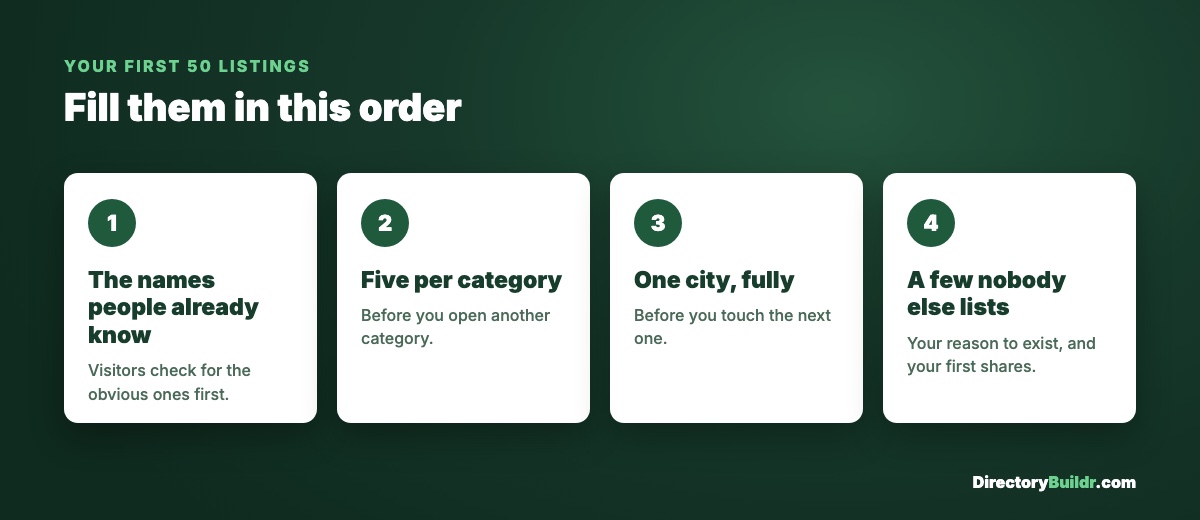
1. The names people already know. Visitors judge a directory in about five seconds by one test: does it have the obvious ones? Someone searching for the best cold plunge tub has already heard of two or three brands. If those aren't on your page, they assume the rest of your list is incomplete too, and they leave.
2. Enough per category. Get at least five listings into a category before you open another one. A category page with one listing is a thin page, for visitors and for Google. Fewer categories with real depth beats a long menu of empty ones.
3. One place, fully, if you're local. Cover one city properly before you touch the next. In the niche research guide, "cold plunge austin" got 320 searches a month. A page with every Austin studio on it can compete for that. Fifty cities with one studio each can't compete for anything.
4. A few that nobody else lists. The new studio that opened last month. The small brand with great reviews that the big roundups ignore. These are your reason to exist. They're also the listings most likely to share your page, because nobody else has featured them.
Where to find them
You need a list of candidates before you write anything. These are the sources I'd check, depending on the niche:
- Google Maps for local businesses. Search the category in your target city and work through the results.
- Competing directories and "best of" articles. Use them as a checklist of names, never as a source of text. Copying their descriptions gives you duplicate content and a reason for Google to ignore you.
- Reddit threads. Search the subreddit for "best" or "recommend". Real users name the places and products they actually use, including the ones that never show up in the paid roundups.
- Associations, member lists and event exhibitor lists. These are often the most complete list of businesses in a niche, and they're publicly posted.
- Brand sites and marketplaces for product directories. Count the models, not just the brands.
Put every candidate in a spreadsheet first: name, URL, category, location, source. Then pick your 50 from that list using the order above.
What every listing needs
Each listing should have the basics filled in, every time:
- Name, website and category
- Location (for local directories)
- A short description in your own words
- At least one image you're allowed to use, such as the business's logo or a photo they've given you permission for (more on that in the data guide)
Then add three to five fields specific to your niche. These are what make a directory more useful than a Google search. For a sauna and cold plunge studio, that might be:
- Price per session
- Water temperature
- Sauna on site, yes or no
- Walk-ins or booking only
Those niche fields become your filters later. Nobody filters by "name." They filter by "has a sauna" and "under $40."
Finally, add one detail you checked yourself. A price you confirmed, an opening date, a note on what's included. That one detail is the difference between a listing and a copy of someone else's listing.
How long it takes
Budget roughly 10 to 15 minutes per listing once your template is settled. The first ten will take longer, because you're still deciding what goes in.
So 50 listings is somewhere around 8 to 12 hours of work. Spread across two weeks, that's under an hour a day.
That's real time, and it's the part most people want to skip. But it's also the cheapest research you'll ever do on your niche. You'll find out which details are hard to get, which businesses have terrible websites, and which ones are already closed.
After 50: scale it
Once the template is settled, importing makes sense. This guide covers scraping and cleaning directory data without typing it all in. Your hand-made 50 become the quality bar: every imported listing should look like one of them, not like a raw spreadsheet row.
One more thing worth doing at this point. Email the businesses you've listed and tell them they're on your directory. Some will ignore you. Some will send corrections, which makes your data better. And some will share or link to their listing, which is how a brand-new directory gets its first backlinks.
The checklist
Before you import anything, you should have:
- A spreadsheet of candidates, with the source for each one
- The well-known names in every category
- At least five listings in every category you've opened
- One city covered properly, if you're local
- Three to five niche fields on every listing, all filled in
- A description in your own words on every listing
If you haven't picked a platform yet, the two questions that decide which directory tool you need will narrow it down. And what makes a good online directory covers what to build around these listings once they're in.
Want the directory built and seeded for you? Get in touch.