
A new directory has a chicken-and-egg problem with links. Nobody links to a site they've never heard of, and Google is slow to trust a site nobody links to.
The usual advice is a list of fifty link-building tactics. Most of them were written for blogs, and a directory has an advantage a blog doesn't: every business you list is a site that might link back.
So before the advice, here's what this site's own backlinks look like.
What 235 backlinks actually turned out to be
In October 2026 I pulled the backlink data for directorybuildr.com from Keywords Everywhere. It reported 235 backlinks.
That sounds healthy until you look at where they come from. 235 links, but only 14 websites.
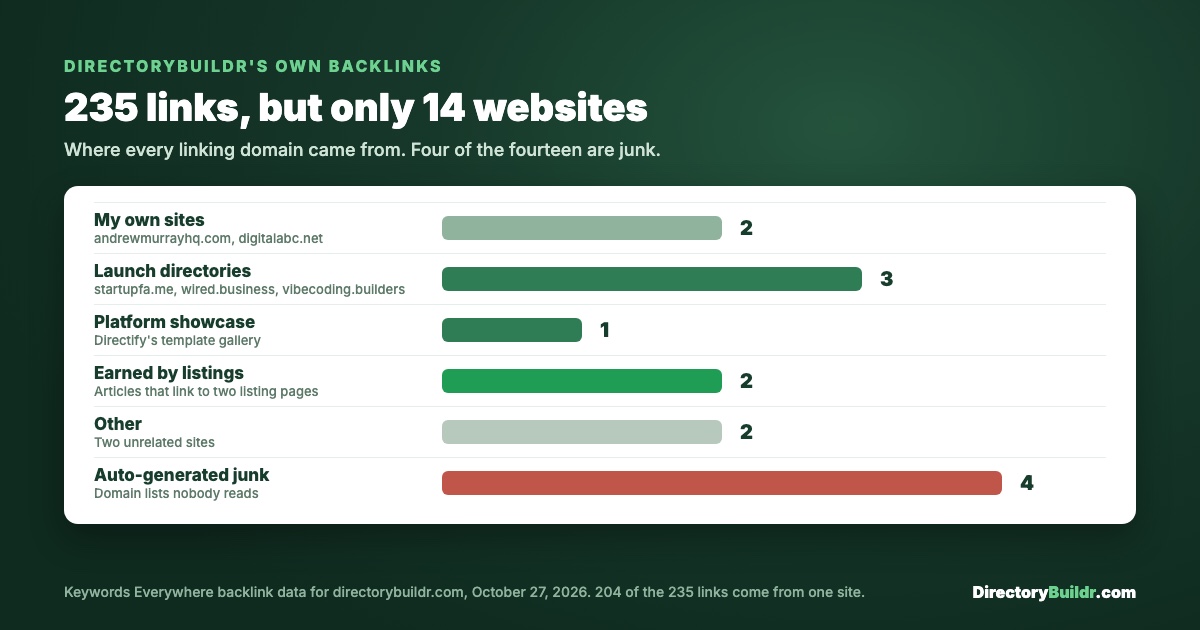
- 204 of the 235 come from one site, my own blog at andrewmurrayhq.com. Another 13 come from digitalabc.net, which is also mine.
- Three are launch directories: startupfa.me, wired.business and vibecoding.builders.
- One is Directify's template gallery, which shows sites built on its platform.
- Two were earned by listings. Other sites wrote articles that linked to the Directory Easy and Listdom listing pages here.
- Two are unrelated sites that linked for their own reasons.
- Four are auto-generated domain lists that nobody reads.
Three lessons are hiding in that list, and they shape everything below.
Count linking sites, not links
The number that matters is 14, not 235.
A site that links to you two hundred times from its sidebar is still one site vouching for you. A big link count from one source tells Google very little it didn't learn from the first link.
Search Console counts the same way. Its Links report lists your top linking sites and sorts them by how many links each one sends, so one site with a sitewide link can sit at the top of the list and inflate your total. Read the number of sites, not the total.
If you're tracking progress, track one number: how many different websites link to you. For a new directory, going from 3 to 15 is real progress. Going from 50 links to 500 from the same three sites is not.
Where a new directory's first links come from
Here's the order I'd work through them in, with roughly an hour a day.
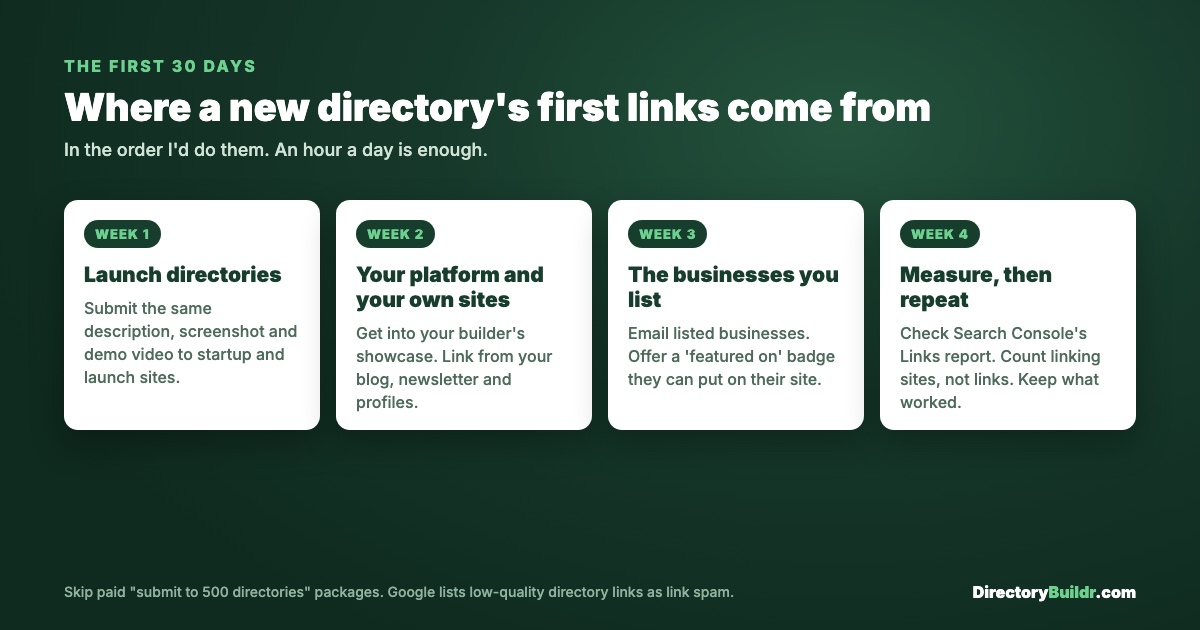
Week 1: launch directories
Startup and launch directories exist to list new sites. This is the easiest category of link a new project will ever get, and three of this site's 14 came from here.
Write one description, take one good screenshot, record a short demo video if you can, and submit the same package everywhere. Product Hunt is the obvious one. There are dozens of smaller ones, and lists of "Product Hunt alternatives" will give you a few hours of submissions.
Two honest caveats. Many of these mark their links nofollow, so they pass little ranking value on their own. And some charge for a listing. Don't pay. The point of this week is to get your site in front of people and in front of Google's crawler, cheaply. A free listing on a site a real person might browse is worth more than a paid one on a site nobody visits.
There's also something useful in this for you specifically: launch directories are directories. Submitting to twenty of them teaches you more about what makes a submission form, a listing page and a claim flow work than any article will.
Week 2: your platform and your own sites
Two easy wins people forget.
Your builder's showcase. Many directory platforms and themes run a gallery of sites built with them. Directify has a template gallery, and that's where one of this site's links comes from. Ask your platform if there's a showcase and how to get in. A WordPress theme author's "sites using this theme" page counts too.
Everything you already own. Your personal blog, your other projects, your newsletter archive, your social profiles. 217 of this site's 235 links come from two sites I own, which is exactly why the raw count is misleading. Those links are still worth having. They get Google to crawl the new site sooner, and a link from an established blog in the same topic is a reasonable signal. Just don't mistake them for outside endorsement.
Week 3: the businesses you list
This is the source that belongs to directories alone, and it's the one most people never use.
Every business on your directory has a website. Some of them will link to their listing if you give them a reason to. Three ways to give them one:
- A "featured on" badge. Make a small, decent-looking badge that says the business is listed on your directory, with a snippet of HTML that links to their listing page. Businesses put these on their sites because it reads as a credential. Email it to them with a link to their listing.
- The claim email. When you invite a business to claim its listing, it's already looking at its own page on your site. That's the moment it's most likely to share or link to it. Mention the badge in the same email.
- Listings worth linking to. The two earned links on this site went to listing pages, not the homepage. Someone writing about Directory Easy or Listdom found a page that said something useful about the tool and linked to it. That only happens when a listing has more to say than the tool's own homepage, which is the same thing that gets it indexed in the first place.
A note on expectations. Most businesses you email won't do anything. That's normal. If you list 50 businesses and five link back, that's five relevant sites in your niche that you'd have struggled to get any other way. Your first 50 listings are your first 50 outreach targets.
Week 4: measure, then repeat
Open Search Console, go to Links, and look at Top linking sites. Write down how many there are. Then check which of the three sources above produced anything.
Whatever worked, do more of it. If the badge got two businesses to link, email the next fifty. If launch directories sent visitors who signed up, find ten more. If nothing worked, the listings themselves are usually the problem: thin pages don't get linked to.
Search Console takes a while to show new links, so don't panic if week four looks empty. Check again a month later.
The shortcut that hurts
Search for "directory submission" and you'll find packages offering to submit your site to 500 directories for a small fee.
Skip them.
Google's spam policies list "low-quality directory or bookmark site links" as an example of link spam, alongside buying links for ranking. The directories in those packages are exactly that: sites that exist to sell submissions, with no visitors and no editorial standard.
At best the links are ignored. At worst they're the kind of pattern that gets a whole site's links discounted. Either way you've paid for nothing.
Ignore the junk you didn't ask for, too. Four of this site's 14 linking domains are auto-generated domain lists. Every site collects these. Google's own guidance on its disavow tool says most sites will never need it, because Google can usually work out which links to trust by itself. Don't spend an afternoon disavowing spam you didn't create.
Why this matters more for a directory than a blog
A blog post can rank on the strength of one great page. A directory needs Google to trust and index hundreds of similar-looking pages, and a site with zero outside links gives Google very little reason to.
That's why the first dozen linking sites matter so much. You're not trying to rank for competitive terms yet. You're trying to show Google the site is real, used, and worth crawling deeper.
The checklist
- Check your current linking sites in Search Console, and count sites, not links
- Submit to launch directories with one consistent package, and don't pay for listings
- Get into your platform's showcase or theme gallery
- Link from the sites and profiles you already own
- Make a "featured on" badge and send it to every listed business
- Put the badge in your claim invite email
- Make listing pages good enough to link to
- Skip paid bulk directory submissions
- Ignore spam links you didn't build
- Recount in 30 days and do more of what worked
If you're still picking a niche, validating it with search data comes first. And if you'd rather have a directory built with listings, claims and the outreach set up from day one, get in touch.

Written by
Andrew Murray
I build niche directories and write up what actually works. I ended up writing a guide by accident - because I was clarifying my own process. So I started giving it away for free. And people seem to find it helpful. Grab the guide here.
Visit website