
My Directify account has 66 directories in it right now. Some are mine, some I built for clients, and a few are tests that never went anywhere.
That last group taught me the most.
Building a directory website isn't hard anymore. The software got easy years ago. What's hard is the order you do things in. Most failed directories didn't fail because of the platform. They failed because someone picked a theme before they picked a niche, or imported 2,000 listings before they knew what a good listing looked like.
So this guide is the order. Ten steps, each with a deeper guide linked if you want the detail.
The short version
- Pick a niche you can describe in one sentence.
- Check the search demand is real.
- Choose a platform by how you want to work, not by features.
- Plan your categories and tags.
- Add your first 50 listings by hand.
- Fill the rest with data you didn't type.
- Write listing pages Google will actually index.
- Turn on claim listings.
- Pick one way to make money first.
- Get your first backlinks.
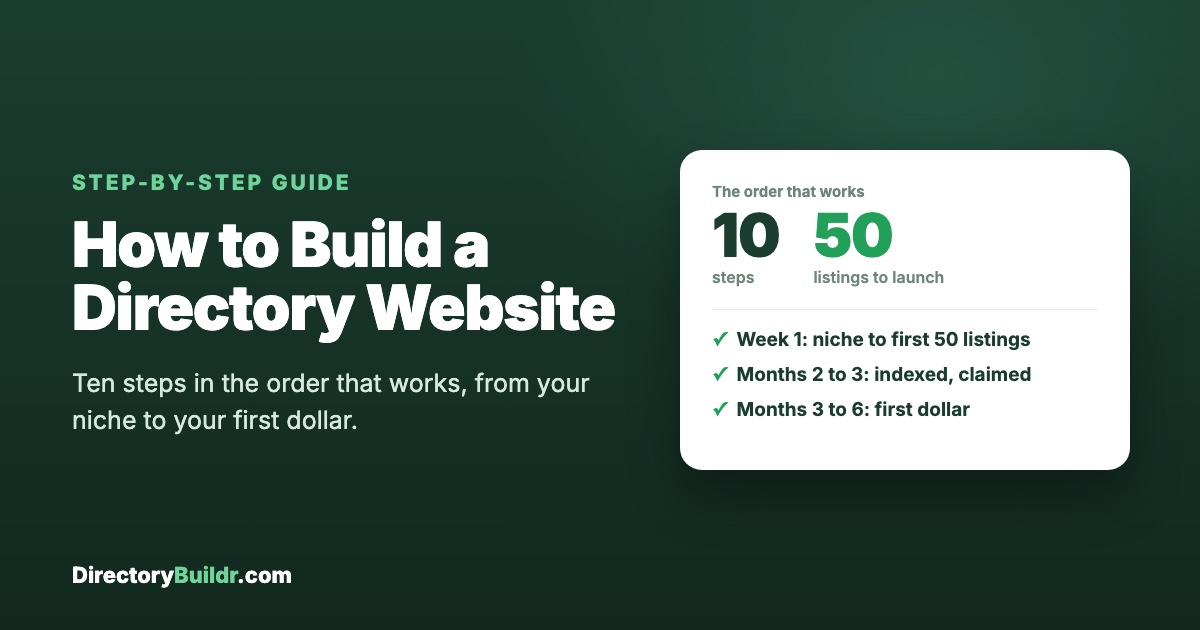
You can do steps 1 to 5 in a week. Steps 6 to 10 are the next few months.
Step 1: Pick a niche you can describe in one sentence
"A directory of AI tools" is not a niche. Thousands of those exist, and most of them are dead.
"A directory of no-code tools for building directories" is a niche. So is "cold plunge and sauna studios in Texas." You can say who it's for and what's on it in one breath.
Narrow beats broad because a small directory can be the best one in its corner. A broad directory is never the best at anything.
If you're still at the idea stage, start with how to find a hyper-niche. For local businesses, read how to choose a profitable local niche.
Step 2: Check the search demand is real
Keyword tools show you the biggest number first. That number lies to you.
On October 23, 2026, I checked one idea: cold plunge and sauna studios. "Sauna near me" gets about 165,000 US searches a month. A new directory will never rank for it.
The keywords that decide whether the niche works are much smaller. "Cold plunge austin" gets 320. "Best cold plunge tub" gets 1,000. Those are winnable, and there are hundreds of them.
What you're looking for is lots of small, specific searches, not one big one. Here's how to validate a directory niche with search data.
Step 3: Choose a platform by how you want to work
Most people ask "which directory builder is easiest?" That's the third question.
The first two are: how do you want to build (clicking, configuring, coding, or paying someone), and how much do you care about owning the code? Answer those, and the platform mostly picks itself. The two questions that decide which directory tool you need walks through it.
For reference, here's what the hosted options I've reviewed cost, as of October 27, 2026:
| Platform | Cheapest plan with payments | Lifetime deal | Best for |
|---|---|---|---|
| Directify | $39/month (Pro) | No | The most complete feature set. This site runs on it. |
| Directory Easy | $11.99/month | Yes, from $199 | Running several directories, paying once |
| MakeADir | $39/month (3 sites) | No | AI help filling a new directory |
If you'd rather use WordPress, plugins like GeoDirectory and themes like Voxel give you full control, at the cost of maintaining it yourself.
Step 4: Plan your categories and tags
Categories and tags do different jobs.
A category answers "what is this?" Category pages are also landing pages, so they're often the pages that rank.
A tag answers "is this for someone like me?" Free, lifetime deal, beginner-friendly. Tags are how a visitor narrows a list down.
Here's a mistake I made: DirectoryBuildr had four pricing tags from January 2026. By September, not one listing used them. A filter with nothing in it is worse than no filter, because a visitor clicks it, sees zero results, and decides the site is empty.
Plan fewer than you think you need. How to structure directory categories and tags has the details.
Step 5: Add your first 50 listings by hand
Fifty listings is roughly the point where a directory stops looking empty.
Do them by hand. Not because scraping is wrong, but because you don't know your fields yet. By listing 20, you'll have changed your fields twice. Import 2,000 listings before that happens, and you'll be fixing 2,000 listings later.
How to get your first 50 directory listings covers where to find them and what each one needs.
Step 6: Fill the rest with data you didn't type
Once you know what a good listing looks like, scale it.
For local directories, Google Maps already has the name, address, phone, hours and rating for nearly every business you want. Tools like Outscraper and Bright Data pull it into a spreadsheet. Bright Data's free tier covers 5,000 records a month, which is enough for most local directories.
The scrape is the easy part. The clean-up decides whether the listings are worth anything. How to fill a directory with data compares the tools and covers the clean-up.
Step 7: Write listing pages Google will index
Open Search Console on a new directory and the biggest grey bar is usually "Crawled, currently not indexed." Google visited the page, read it, and decided it wasn't worth keeping.
On a directory, that's almost always the listing pages. And the reason is almost always the same: the page says exactly what Google Maps or the business's own website already says.
The fix is to add something the source doesn't: who the listing suits, who it doesn't, a price range, what makes it different. One honest line per listing is often enough. How to write directory listing pages Google will index shows how.
Step 8: Turn on claim listings
Every listing you add is a business that doesn't know it's on your site.
A claim changes that. The owner finds their listing, proves it's theirs, and takes over keeping it accurate. It's also your first conversation with them, which matters when you want to sell them something later.
Set it up before you have traffic, not after. How to set up claim listings.
Step 9: Pick one way to make money first
There are at least seven ways a directory makes money: affiliate links, featured listings, paid submissions, leads, ads, memberships and selling data. This overview covers all of them.
Don't start with seven. Each one needs a different amount of traffic before it pays. Affiliate links can pay on the first sale. Featured listings need businesses who've seen your traffic. Ads need a lot of visitors.
Pick the one that fits where you are today. Which money model to start with puts them in order.
Step 10: Get your first backlinks
Nobody links to a site they've never heard of, and Google is slow to trust a site nobody links to.
Here's what that looked like on this site. In October 2026, DirectoryBuildr had 235 backlinks. They came from only 14 websites. Four were auto-generated domain lists that nobody reads.
The two that mattered were earned by listings. Other sites wrote about tools listed here and linked to the listing pages. That's the advantage a directory has over a blog: every business you list is a site that might link back.
How to get your first backlinks for a new directory breaks down the whole list.
How long it takes
Here's a realistic timeline for a part-time builder:
- Week 1: Niche, validation, platform, categories, first 50 listings.
- Weeks 2 to 4: Scrape, clean and publish in batches of about 50.
- Months 2 to 3: Google starts indexing listing pages. Claims and first outreach.
- Months 3 to 6: First affiliate commissions or first paid listing, if the niche was right.
That last line has an "if" in it on purpose. Some of my directories hit it. Some didn't, and that's what steps 1 and 2 are for: finding out cheaply.
FAQ
How much does it cost to build a directory website? A hosted directory builder costs $0 to $39 a month to start, plus about $15 a year for a domain. Scraping your first few hundred listings can be free. The real cost is your time.
Do I need to know how to code? No. Directify, Directory Easy and MakeADir are all no-code. WordPress with a directory plugin needs more setup but still no code.
How many listings do I need to launch? About 50. Enough that no category page is empty.
How long until a directory makes money? Usually 3 to 6 months for a first dollar, if you start with affiliate links. Featured listings and leads take longer because businesses need to see traffic first.
Can a directory website still rank in 2026? Yes, if the listing pages say something the original source doesn't. Copied data is what doesn't rank.
Want help building yours?
If you want the whole process with templates and walkthroughs, that's what the DirectoryBuildr course is for.
If you'd rather start free, get the directory launch guide and work through it at your own pace.

Written by
Andrew Murray
I build niche directories and write up what actually works. I ended up writing a guide by accident - because I was clarifying my own process. So I started giving it away for free. And people say they find it really helpful in planning their directories. Click the link below to grab my free guide 👇
Visit website